On the ground, a playground project rarely starts with a catalog of equipment. It begins with a constraint: a sloping site, a tight budget, an adjacent school, or clay soil that does not drain. It is from these concrete data that a safe play area for a community is built, not the other way around.
Site layout and organization: what happens before the first piece of equipment

The implementation phase is often underestimated. The compliance of a playground is not limited to the equipment itself: it includes the overall organization of the site. Orientation, distances from roadways, fencing, visibility from the accompanying benches—all of this affects safety as much as the slide itself.
A concrete example: if the playground is bordered by a municipal road, the buffer zone between the fence and the first play structure must be sufficient so that a running child does not end up on the roadway in case of unsupervised exit.
We also consider sunlight. A playground facing south without shade becomes unusable in summer, and the landscaping of the site is no longer just an aesthetic choice. Planting deciduous trees in the right places protects children from the sun in July while allowing light to pass through in winter.
To learn everything about playgrounds for communities, one must first accept that the choice of site is as important as the choice of equipment. A poorly thought-out location generates compliance costs that burden the initial budget.
Shock-absorbing surfaces: the NF EN 1177 standard in practice

The ground is the most technical aspect of a playground, and where errors are the most costly to correct. The NF EN 1177 standard requires that the surface absorbs falls based on the free fall height of each piece of equipment. The higher the play structure, the more the ground must absorb the impact.
In practice, there are three main types of surfaces:
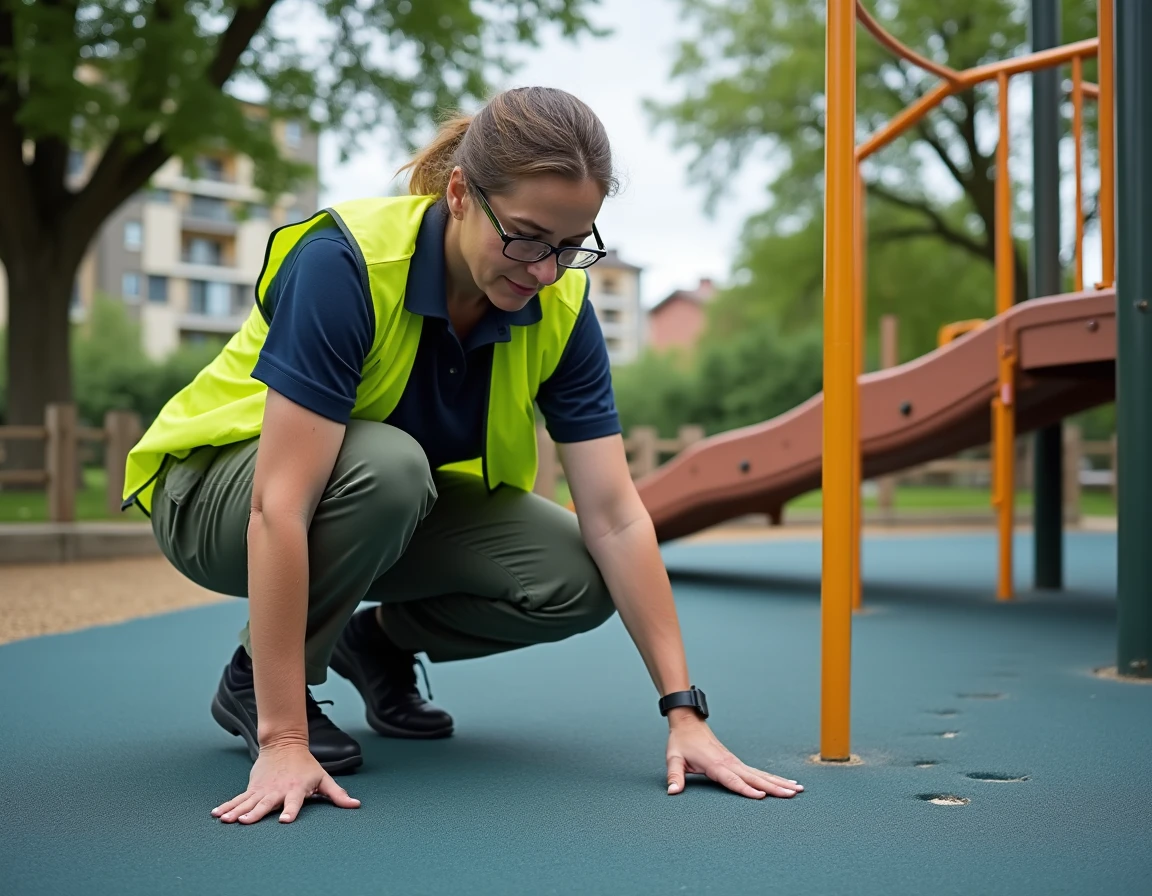
- Cast-in-place surfaces (EPDM, recycled rubber): they offer a continuous surface, accessible to wheelchairs, but their installation requires a stable and drained base. On clay soil, without an appropriate foundation layer, they crack in less than two winters.
- Wood chips or bark: an economical solution, easy to implement, but requiring regular replenishment. The fill level decreases over time, and if not monitored, the shock-absorbing thickness is no longer sufficient.
- Prefabricated shock-absorbing tiles: a compromise between durability and cost, but beware of joints that lift and create trip hazards.
The choice depends on the budget, the type of natural soil, and the community’s ability to ensure maintenance. A poorly maintained poured surface becomes more dangerous than a well-monitored bed of chips.
Equipment compliance: decree, standards, and manager’s responsibility
Decree No. 96-1136 of December 18, 1996, sets the French regulatory framework. The NF EN 1176 standard (parts 1 to 11) details safety requirements by type of equipment: swings, slides, climbing structures, spring toys, merry-go-rounds, zip lines, trampolines. Each category has its own safety zones, minimum distances, and opening dimensions to prevent head or limb entrapment.
What the manager must check, not just the manufacturer
It is sometimes believed that purchasing certified equipment is sufficient. This is not the case. The manager’s responsibility covers installation, maintenance, and periodic inspection. Equipment that is compliant at the factory can become non-compliant if the spacing between two structures is not respected during assembly, or if a modification is made on-site without recalculating the safety zones.
Feedback varies on this point, but most inspection offices recommend three levels of inspection:
- A weekly visual inspection (general condition, cleanliness, absence of hazardous debris)
- A functional inspection monthly or quarterly (wear of moving parts, fastenings, condition of the ground)
- An annual in-depth inspection by a qualified organization, with a written report
Without these checks, the community exposes itself to direct liability in the event of an accident.
Inclusion and accessibility from the design phase of the playground
For a long time, accessibility was treated as an afterthought: a ramp was added afterward, a sensory panel was added at the edge of the site. This approach is outdated. Communities that rethink their playgrounds now integrate inclusion from the design phase, not as an afterthought.
In practical terms, this means planning continuous and accessible pathways for wheelchairs between play areas, but also offering equipment usable by children with varying motor or sensory abilities. An accessible merry-go-round, a bucket swing, tactile panels integrated into the main structure rather than relegated to a corner.
This approach aligns with the health-environment trend that increasingly frames local development projects. The playground is no longer seen as just a recreational facility, but as a lever for well-being and quality of life at the neighborhood level. The chosen materials (certified wood, recycled steel, solvent-free paints) contribute to this logic.
A final often-overlooked point: signage. Regulatory information panels (age ranges, emergency numbers, contact details of the manager) must be readable, up-to-date, and positioned at the entrance of each area. An administrative detail, indeed, but it is the first element checked during an inspection.