The education of children is a fertile ground for pedagogical innovation, where pleasure and learning intertwine to stimulate development. Faced with the challenge of maintaining the attention of young minds while imparting essential knowledge, parents and educators are turning to methods that incorporate gamification. This approach, which integrates game elements into the learning environment, has the potential to transform study sessions into captivating adventures. The goal is to create a synergy between awakening children’s natural curiosity and assimilating key skills, going beyond traditional teaching methods.
The importance of balancing pleasure and learning in children’s education
In the meanders of the current educational system, Child Nature pedagogy emerges as a beacon of hope, promoting teaching where combining pleasure and learning is not a luxury but a necessity. Théo, 8 years old, dives into the imaginary by manipulating small characters, while Maxime, aged 4 and a half, sketches the outlines of a wolf and a little man on paper, acts of creation that combine emotion and intelligence. Ben, 6 and a half, a bright student, finds in the games he loves an unmatched source of motivation, proving that pleasure can be an effective vector for education.
Élisabeth Lavallée, who holds a master’s degree in physical activity sciences and is a doctoral student in biomedical sciences, has worked on this pedagogy aimed at the holistic development of children. She asserts that the joy of learning must be at the heart of school, as it is the driving force behind perseverance and academic success. Her study emphasizes that when children are happy to learn, they develop a positive relationship with knowledge that will accompany them throughout their lives.
In classrooms where children’s laughter resonates, learning transforms. Pleasure then becomes a criterion for educational success, positively influencing students’ motivation and engagement. ‘Butterfly Mag’ recently highlighted initiatives where children, through play, learn to read, write, and count without even realizing it, thus illustrating the effectiveness of this approach.
Child Nature pedagogy, beyond its playful aspect, is a response to the need for teaching tailored to each child. It offers personalized educational strategies and allows children to thrive through a variety of activities that respect their learning pace. The joy of learning, if cultivated from a young age, sows the seeds of successful education and a quest for knowledge that will continue throughout life.
Practical strategies for integrating play and discovery into the educational process
Faced with a school often stuck in its traditions, the Child Nature Cooperative and the University of Quebec at Trois-Rivières (UQTR) are joining forces to inject a breath of fresh air. These institutions propose methods where experiential outdoor education takes root, inspired by the Scandinavian ‘Forest School’ model. It is no longer about imparting knowledge in the austerity of classrooms but experiencing it outdoors, where the senses are awakened and movement reigns.
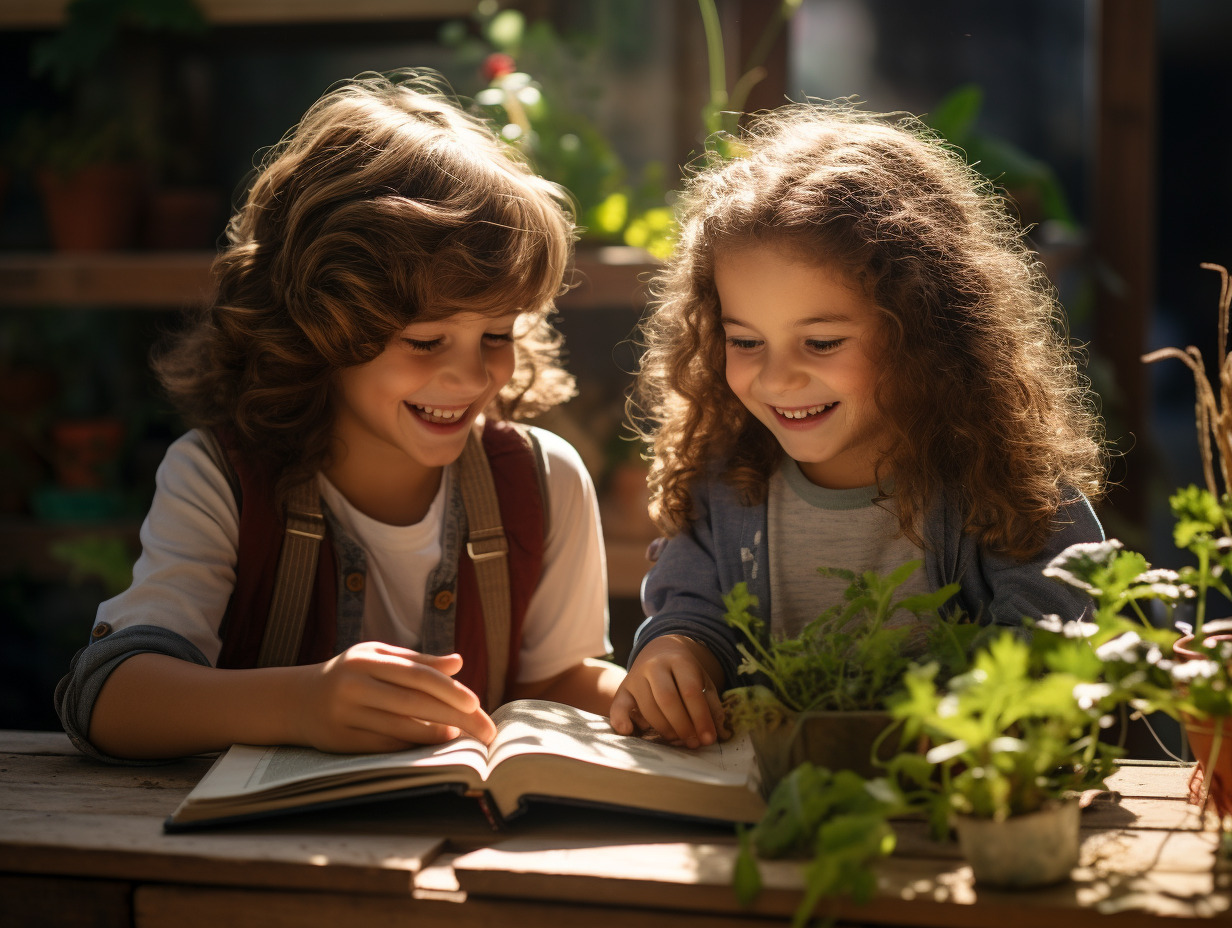
The approach materializes in educational strategies where nature itself becomes a wall-less learning space. Anastasia and her sister Laure discover botany through gardening, physics by observing the flow of a stream, and geometry by building huts. These activities, far from being mere pastimes, are actually disguised primary and kindergarten education lessons, where every interaction with the environment is a lesson that firmly embeds itself in the curious minds of children.
This pedagogical revolution challenges national education: is it ready to rethink its frameworks to embrace these innovative practices? As Élisabeth Lavallée continues her doctoral studies in biomedical sciences at UQTR, preliminary results from her research suggest that the benefits are tangible. Children who benefit from this physical activity combined with learning are not only more engaged in their education but also develop essential social and emotional skills. Play and discovery, far from being distractions, prove to be powerful educational tools.