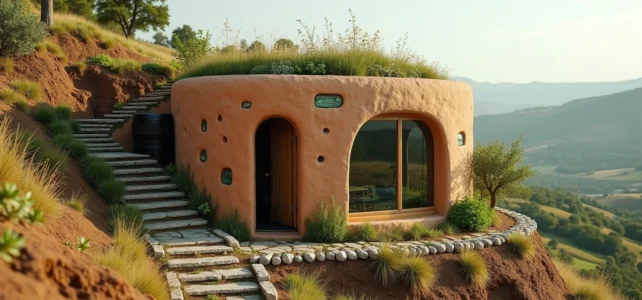
An alternative house refers to any habitat whose design breaks away from the classic single-family home model, whether through the materials used, the living space, or the relationship to the energy network. Tiny houses, straw constructions, reversible modular habitats: these forms of housing share a common foundation, which is to reduce both the construction cost and the ecological footprint of residential buildings.
Agricultural co-products and insulation: the new generation of bio-based materials
The wood, straw, and hemp sectors are now well documented. What is progressing more discreetly are the bio-based materials derived from agricultural co-products: rice husks, brewery spent grains, sunflower residues. The HQE-GBC Alliance and the CSTB report, in their recent work on low-carbon construction materials, an increase in Technical Opinions and ATEx for blocks, panels, and insulators made from these residues.
The interest is twofold. On one hand, the thermal performance of these insulators rivals that of hemp or cellulose wadding. On the other hand, their production valorizes agricultural waste that would have ended up in compost or incineration, thus reducing the overall carbon footprint of the construction site.
For project holders looking to compare different construction sectors, the resources available at https://maisonsalternatives.fr/ allow for cross-referencing technical options according to budget and local climate.
These materials remain more difficult to source than wood or straw, as distribution channels are not yet structured on a national scale. A construction site in Occitanie will easily find rice husks, while a project in Brittany will more naturally turn to flax or buckwheat residues.
Alternative houses and the zero net artificialization goal
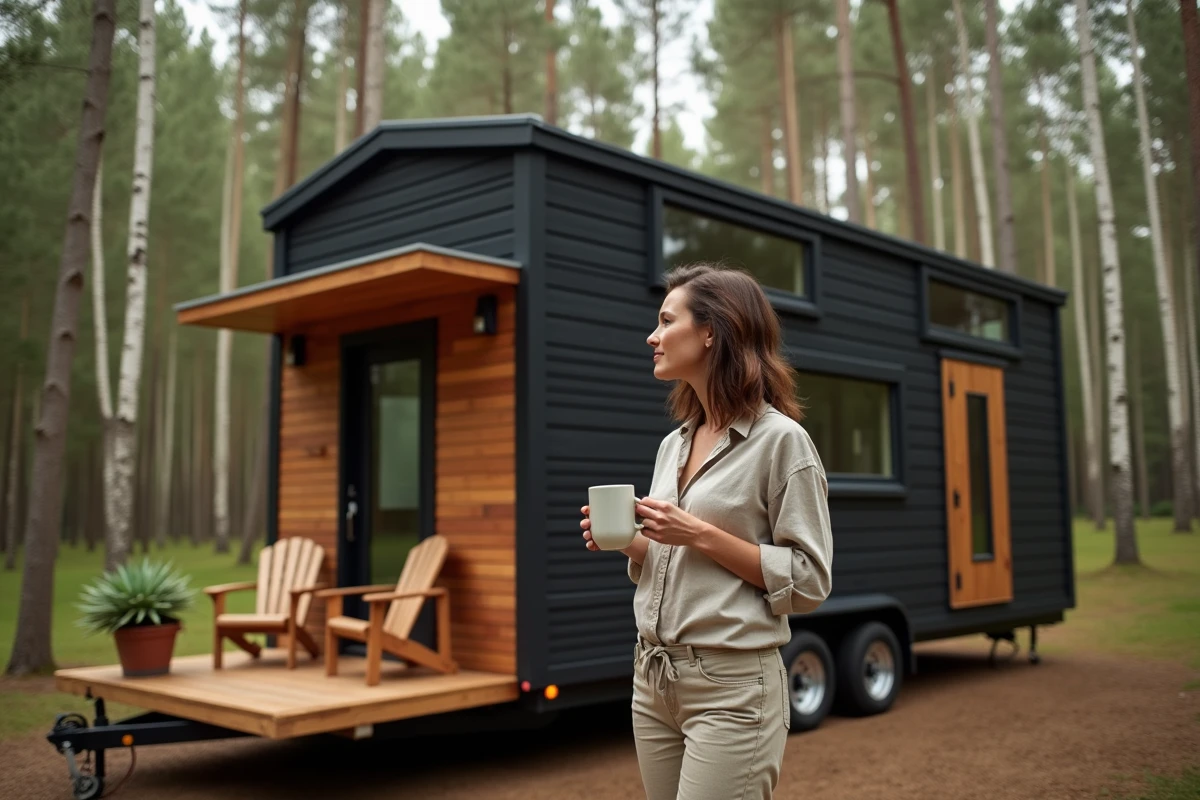
The Climate and Resilience Law has set the goal of Zero Net Artificialization (ZNA) by 2050. Several French regions now consider tiny houses, modular micro-habitats, or reversible constructions as tools to achieve this goal, according to the supporting document from the Ministry of Ecological Transition published in 2023.
The reasoning is simple: a reversible habitat, placed on stilts or on light foundations, does not seal the ground in the same way as a concrete slab. At the end of its life, the land can return to its agricultural or natural vocation.
Reversibility and building permits
Reversibility does not exempt from urban planning permissions. Depending on the floor area and duration of installation, a prior declaration or building permit is still necessary. The regulatory distinction concerns the removable nature of the structure, not its size.
A removable habitat is not a habitat without rules. The Local Urban Plans (PLU) of certain municipalities are gradually incorporating zones dedicated to light habitats, but the majority of the territory does not provide anything specific. Checking the PLU before purchasing land remains the first step of any project.
Off-grid habitats: solar micro-networks and sharing among neighbors
Several European territories are experimenting with developments designed from the outset to operate off-grid. The principle relies on the combination of solar panels, storage batteries, and sometimes micro-wind turbines, with a sharing of equipment among neighbors.
The “Off-Grid Communities” project documented by Interreg North-West Europe describes hamlets where energy production and storage are shared. This model reduces the individual cost of installations and smooths out consumption peaks, especially in winter.
How energy autonomy changes daily life
Living off-grid imposes concrete trade-offs on energy and water consumption. Traditional electric heating rarely becomes viable, which leads to solutions like wood stoves, mass stoves, or solar thermal for hot water.
- Water management often involves rainwater harvesting coupled with a filtration system, supplemented by well or tank during dry periods.
- High-performance thermal insulation (straw, wood fiber, agricultural co-products) drastically reduces the need for heating and makes energy autonomy realistic even in cold climates.
- The sizing of storage batteries directly depends on the living space and the number of occupants, favoring habitats with reduced surface area.
Straw and wood construction: real cost and limits to know
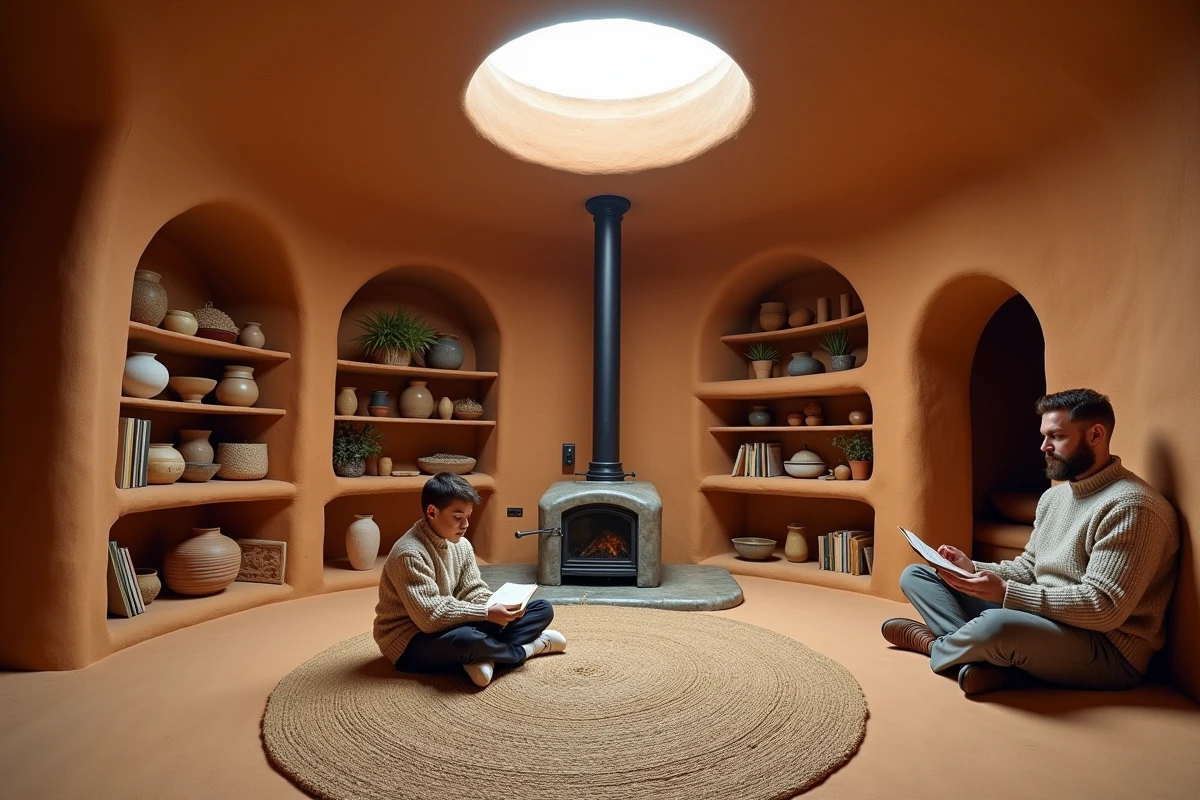
Wood and straw construction remains the most accessible sector for an ecological alternative house project. Wood provides the load-bearing structure, while straw fills the cavities for insulation. The whole forms a wall with very low thermal conductivity, which limits heating consumption over the entire lifespan of the building.
The construction price per square meter strongly depends on the level of self-construction. A participatory construction site where the owner performs the straw filling significantly reduces the bill compared to a fully delegated site. However, self-construction requires prior training, as poorly compacted filling creates thermal bridges and risks of settling.
Insurance and resale: two points of friction
Insuring a straw or wood house remains possible, but the number of insurers willing to cover these constructions is more limited than for classic single-family homes. The builder or self-builder must provide a certificate of compliance with professional rules for straw construction (CP 2012 rules).
Resale poses a different question. The resale market for alternative houses remains narrow, concentrated on already sensitized buyers. An atypical property generally takes longer to find a buyer than a standard pavilion, which should be considered in the project planning phase.
The development of alternative houses is part of a regulatory and technical movement that goes beyond just the lifestyle question. Between the ZNA goal, new bio-based materials, and energy micro-networks, the practical conditions for living differently become clearer each year, even if administrative and insurance barriers remain very real.